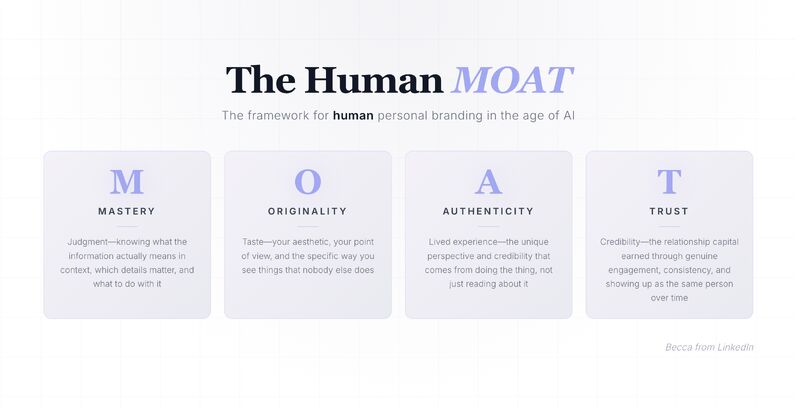
The Human MOAT!

Popped across this LinkedIn article by Becca Chambers and loveeddd it. Its running in the same vein of the other AI topics we’ve touched on (judgement, taste, etc)

“No moat, you’re a commodity. Commodities get replaced.” :fire: :fire:

M — Mastery
Human mastery requires judgement. AI can process information faster than any human alive. But processing information isn’t mastery, it’s a starting point. Real mastery is the judgment to know what the information actually means in context—which details matter, which rules apply, and why this moment is different from the last one that looked exactly like it. AI has the data. You have the nuance and context. That distinction matters.

O — Originality
AI does not have taste. It is designed as a median machine that produces the most average, probable answer. Human taste is the *opposite* of average. It’s your aesthetic, your point of view, and the specific way you see things that nobody else does. That original signature is unique to you, and unlike AI, it cannot be averaged into existence.

A — Authenticity
AI has no lived experience. It has never been laid off, never had to navigate team dynamics, never been held responsible for a bad decision, burned out, or forced to rebuild. Authenticity is storytelling rooted in your actual history—the lessons that came from doing the thing, not from reading about it. That includes showing vulnerability, failures, and the messy middle of being human that cannot be scraped or simulated.

T — Trust
Your credibility is your capital, and trust is the ultimate reward of a strong personal brand. While AI can replicate a lot of what we do, it cannot build real human relationships. Trust is earned through genuine engagement—showing up consistently, with vulnerability and accountability, as the same person over time. It cannot be manufactured.

All the kudos to her on bringing these ideas together PERFECTLY! You can read the whole post on LinkedIn. :tada: :tada:

3 Likes

Ok, so let’s flip this.

Mastery- I’ve found AI can learn my work, remember everything, and improve fast. In many of my use cases, it can make better choices because it sees more and forgets nothing. Most people are not unlocking its potential.

Originality- I’ll argue that most people don’t have taste. Taste is about seeing patterns and picking what works. AI can mix ideas in new ways and even create new styles, not just average ones. Some of the videos I’m seeing are incredible.

Authenticity- Yes, lived experience matters… but most people just want answers and pretty good results. AI can give you that, even without a personal story.

Trust- Trust grows when something works again and again. If AI shows its sources and is consistent, people will trust it even more than someone blabbing opinions.

I think different domains will evolve at different speeds. Looking at coding, this MOAT has already been disrupted.

The only way to stay ahead is to stay ahead, day by day, step by step. Intentionality. But that was always the case. :slight_smile:

2 Likes

Gadddd, way to leave the peeps out to dry!

Sad Dexters Laboratory GIF by Cartoon Network

1 Like

Thanks for sharing Nat! Funny that this MOAT framework is all about establishing your personal brand value, since I usually think of castle’s moats as creating a silo’d and walled off area.

Also reminds me about how we’re talking about ‘taste’ in this other thread about the leverage of design in this AI world: We're in a World Where Designers Have Huge Amounts of Leverage - #9 by MoData

1 Like

Its an interesting dance IMO! Establishing your brand in a way that feels authentic to you, could be crappy to someone else :woman_facepalming: The idea of taste is challenging because it seems so subjective!

1 Like

Was thinking about this…

I struggle with the “commodity” framing. It assumes the value is in the person. More and more, the value lies in what the person helps produce.

AI has already flattened visible skills, and everyone can generate something that looks good, sounds smart, or feels polished.

So what actually stands out?

  • It’s not just taste.. you have to apply it in a way that changes direction
  • Experience and Mastery has to be used to avoid bad decisions
  • Authenticity. Turning that into trust that moves work forward

I’ve had more and more conversations with people in Engineering land, and it’s clear that this is still about outputs. And if they are driving the AI adoption… then outputs will still be the starting point.

I think this is the biggest leverage that AI has. Also, true that it’s harder for people to consider and understand.

Systems that leverage this will keep compounding

This is interesting because to me, authenticity would presumably be tied to taste. But if AI adoption is being driven from an output mindset, doesn’t that start to erode both? You end up with things that look right, but don’t really move anything.

Like it seems sorta as if AI is stripping away some of those personal “this feels right” moments. You can like the work, but that doesn’t mean it creates lift. And sometimes the work that does create lift isn’t something a designer is proud of stylistically… seems like a tough tradeoff if you ask me. Idk @EricZ, design wiz, thoughts?

I think there are aspects of maturity at play with what you’re describing.

Younger applications tend to have more quirks and personality, and perhaps better reflect the people who initially build the thing.

Middle-aged applications get redesigns and rebrands that perhaps appeal to a broader audience, which probably means it softens the impact it had on its original audience. Is it maturing, or selling out?

Then you have older brands that are kinda the old-boys network. Defense contractors and enterprises building workhorse software for other massive orgs.


I characterize it like this because there often isn’t a lot of space for a designers subjectivity and sense of ‘ownership’ per se. Building from established patterns gets the majority of people on-board and using the product. I think right now AI implementation degrades these patterns or styles somewhat, but that’s improving slowly.

2 Likes

I’ve been thinking about the idea of a “Human MOAT” and where it applies in a world where AI can generate outputs instantly.

Most discussions focus on individual attributes that you highlighted, such as mastery and originality. I think those things still matter a bunch, but I think we’re looking at the wrong level of the system most of the time.

What interests me now is memory.

The strongest teams keep their learnings fresh and active, but as AI increases outputs, these are harder to hold on to.

→ Previous research
→ Past decisions
→ Failed experiments
→ Customer patterns
→ The rationale behind decisions

Outputs are cheap… the advantage shifts to learning.

A team that continuously carries forward what it has learned has a much stronger moat than a team relying on individual expertise alone. I keep coming back to the idea that judgment is becoming a team sport.

The moat isn’t just solo judgment. The moat is becoming the collective judgment supported by memory, signals, and continuous learning.

The organizations that learn faster than their competitors will make better decisions. And the organizations that make better decisions will create better outcomes for their customers.

1 Like

Feels relevant to our “structured outputs” conversations.

Agent memory might be the most important part of a high-functioning AI-system. If you force it to remember “crap”, whether it be overly verbose, too frequent, pointless, or even too extensive, will lead it to not being able to query the right memory and output generic “crap”.

Coming back to the human element, we have to focus on high quality learnings that, hopefully, stick and aren’t tainted by falsehoods.

I think you’re onto something.

We’ve spent a lot of time talking about structured outputs, but I’m increasingly convinced that shared memory is the real moat.

A contributor can have great ideas, but if the learning stays with the individual, the organization doesn’t get much leverage. The value comes when leaders, stakeholders, customers, users, researchers, and AI systems all operate from the same growing body of knowledge.

The challenge is carrying forward the right information.

  • Past decisions
  • Failed experiments
  • Customer patterns
  • Research findings
  • The rationale behind why things happened

When that memory is shared, teams make better decisions. When it isn’t, organizations end up relearning the same lessons over and over again.

The more I think about it, the moat isn’t individual expertise…It’s the individuals’ ability to overlap in shared memory that improves the collective judgment over time. This is where using AI efficiently can be huge.

1 Like

Shared memory is super powerful. I’d be curious to see how others are thinking about this, and perhaps how systems that are being built are tackling this.

My guess is that it also gets complex… when do the learnings and memories matter, and for whom? Perhaps the agent decides that.

Decided to turn this into a post-thanks for the inspiration @ben!

Bringing this back to the individual, I think creating value inside an organization is increasingly about connecting memories. The people who can connect past decisions, research, customer patterns, and new information create leverage for everyone else.

That’s a moat that goes beyond editing, taste, or even judgment- it helps the teams create design impact over time.

2 Likes

Love it!

1 Like

To piggy back here, I think its also not only about ownership, but influence. The more context you can bring into a conversation, the more you help other people make better decisions too.

1 Like